








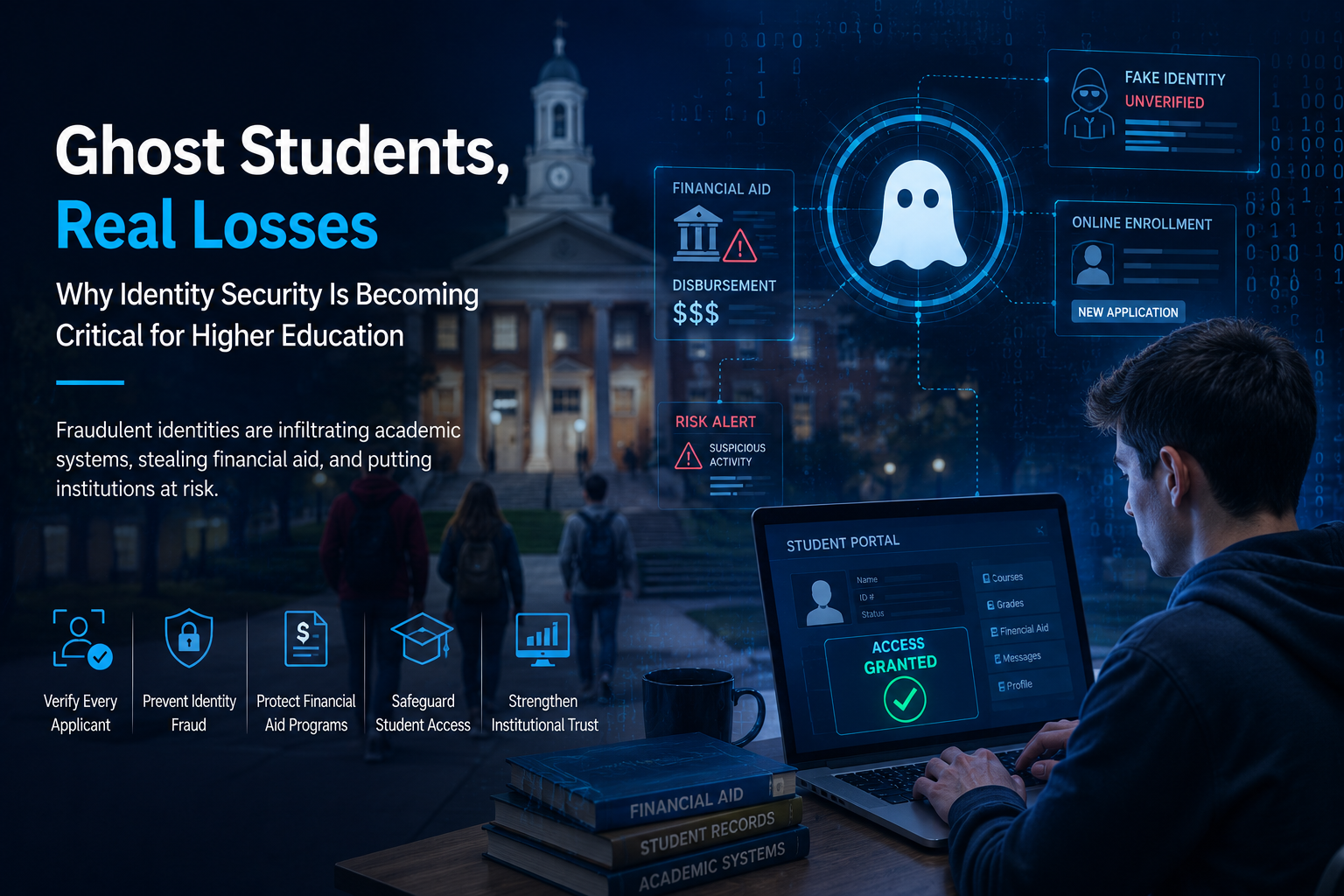
Ghost Students, Real Losses: Why Identity Security Is Becoming Critical for Higher Education
Universities are facing a growing identity fraud problem and many institutions are not prepared for it.
Higher education institutions are accelerating digital transformation faster than ever before.
Online learning platforms, remote admissions, digital financial aid processes, and cloud-based student services have created more flexible and accessible educational experiences for students worldwide.
But this digital convenience is also creating new opportunities for fraud.
At CYBRELI, we are seeing a growing cybersecurity and identity governance challenge across colleges and universities: fraudulent digital identities infiltrating academic systems through fake student applications.
These so-called "ghost students" are becoming an increasingly serious concern for educational institutions, financial aid programs, and administrative teams.
Because in today's digital environment, identity fraud is no longer limited to banking or e-commerce. It is now impacting education at scale.
The Rise of the "Ghost Student"
Ghost students are fraudulent identities created to exploit weaknesses in digital admissions and financial aid processes.
These fake identities often appear legitimate enough to:
- Apply for admission
- Register for courses
- Request financial aid
- Access online learning systems
- Receive disbursements before disappearing completely
In many cases, the objective is not education. The objective is financial fraud.
As online enrollment continues to expand, institutions increasingly face challenges validating whether applicants are genuine individuals or synthetic identities created using stolen or manipulated information.
This creates significant operational, financial, and reputational risks for colleges and universities.
Digital Enrollment Has Changed the Risk Landscape
The rapid growth of online learning and remote enrollment has transformed how institutions interact with students.
While this shift has improved accessibility and scalability, it has also reduced many of the traditional verification checkpoints previously associated with in-person admissions processes.
Today, fraudsters can:
- Submit applications remotely
- Create convincing digital identities
- Use stolen or synthetic information
- Interact with systems entirely online
Without strong identity verification and governance controls, institutions may unknowingly onboard fraudulent users directly into their academic and financial ecosystems.
The challenge is becoming increasingly difficult because identity fraud techniques continue evolving alongside modern digital technologies.
Why Traditional Verification Processes Are No Longer Enough
Many educational institutions still rely on legacy verification processes designed for a much simpler digital environment.
Traditional onboarding workflows often focus primarily on:
- Basic document submission
- Manual reviews
- Password creation
- Standard authentication processes
But modern fraud actors are becoming significantly more sophisticated. Organizations now face challenges involving:
- Synthetic identities
- AI-assisted fraud
- Credential misuse
- Automated enrollment abuse
- Large-scale digital impersonation attempts
As a result, traditional identity validation methods are no longer sufficient on their own. Institutions need stronger identity-centric security strategies capable of validating trust before access is granted.
Identity Security Must Start at the Front Door
One of the most important lessons for higher education institutions is that identity security cannot begin after a user account has already been created. It must begin during the onboarding and admissions process itself.
Modern identity governance strategies increasingly focus on:
- Identity proofing
- Adaptive authentication
- Behavioral analysis
- Access governance
- Continuous identity validation
The objective is not simply to verify that an application was submitted. The objective is to verify that the identity behind the application is legitimate, trusted, and appropriately governed.
This is becoming especially important for institutions managing:
- Online programs
- Remote learning environments
- Digital financial aid services
- Cloud-based student systems
Identity Governance Is Becoming a Strategic Priority for Education
Educational institutions are managing far more than student records.
They are managing:
- Financial data
- Personal information
- Academic systems
- Research environments
- Cloud platforms
- Large digital ecosystems involving students, faculty, contractors, and third-party services
This makes Identity & Access Management (IAM) increasingly critical for both operational resilience and cybersecurity governance.
Modern IAM strategies help institutions:
- Strengthen identity verification
- Improve access governance
- Reduce fraud exposure
- Simplify authentication
- Protect sensitive systems
- Improve visibility across digital environments
More importantly, they help institutions build trusted digital experiences while reducing operational and compliance risks.
Security Must Support the Student Experience
One of the biggest challenges in education cybersecurity is balancing strong security with accessibility and user experience.
Students expect:
- Fast onboarding
- Easy access to systems
- Remote accessibility
- Seamless digital interactions
Security controls that create excessive friction can negatively impact both student experience and operational efficiency.
This is why modern identity security approaches increasingly rely on intelligent and adaptive security models capable of strengthening protection while maintaining smooth user experiences.
The goal is not to create barriers. The goal is to create trusted and secure digital environments.
The Future of Education Security Will Be Identity-Driven
As higher education institutions continue expanding digital services, identity governance will become even more central to cybersecurity strategy.
Organizations that continue relying on fragmented onboarding processes and outdated identity validation methods may face increasing exposure to fraud, operational disruption, and compliance challenges.
Those investing in modern Identity & Access Management strategies today will be significantly better positioned to:
- Reduce fraud
- Strengthen trust
- Protect institutional systems
- Improve operational resilience
- Support secure digital transformation
Identity is becoming one of the most important security layers within modern education environments.
How CYBRELI Helps
At CYBRELI, we help organizations modernize identity security through intelligent, scalable, and business-aligned Identity & Access Management solutions.
Our expertise includes:
- Identity Governance & Administration (IGA)
- Access Management & Federation
- Multi-Factor Authentication (MFA)
- Single Sign-On (SSO)
- Cloud Identity Security
- Privileged Access Management (PAM)
- Zero Trust Architecture
- Identity Verification & Governance Strategies
We help institutions strengthen identity trust, improve governance, reduce fraud exposure, and build secure digital ecosystems designed for the future of education.
Final Thoughts
The future of cybersecurity in higher education is no longer only about protecting networks and systems. It is about protecting identities.
As digital learning, remote onboarding, and cloud-based education services continue growing, institutions must rethink how they validate, govern, and secure digital identities across increasingly complex environments.
The institutions that modernize identity security today will be better positioned to protect students, strengthen trust, and support secure academic innovation in the years ahead.
Secure Identities. Reduce Fraud. Protect Digital Education.