








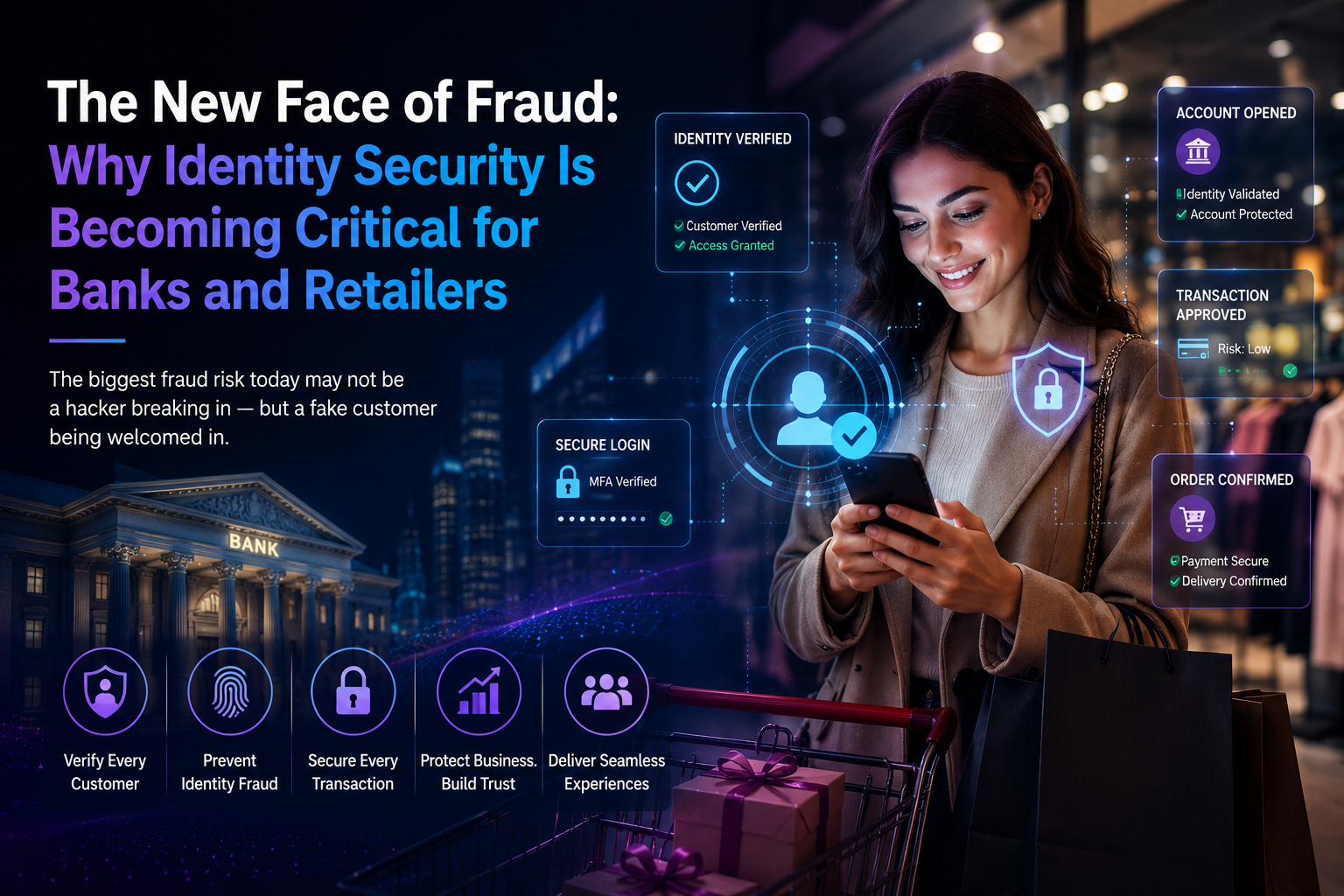
The New Face of Fraud: Why Identity Security is Becoming Critical for Banks and Retailers
The biggest fraud risk today may not be a hacker breaking in but a fake customer being welcomed in.
The holiday season is one of the busiest and most profitable periods for banks, retailers, and digital commerce platforms. Businesses launch aggressive campaigns, onboard thousands of new customers, and process an enormous volume of digital transactions every day.
But while organizations focus heavily on phishing attempts, credential theft, and account takeovers, a much larger challenge is quietly growing beneath the surface.
Modern fraud is evolving.
Today's cybercriminals are no longer relying solely on stolen passwords or brute-force attacks. Instead, they are creating entirely new digital identities convincing enough to pass traditional verification processes and gain legitimate access to systems, applications, and financial services.
At CYBRELI, we believe this shift is changing the future of cybersecurity, fraud prevention, and Identity & Access Management (IAM) across the banking and retail industries.
Fraud Has Changed & Traditional Security is Struggling to Keep Up
For years, most fraud prevention strategies focused on monitoring suspicious user behavior:
- Unusual login attempts
- Unexpected locations
- Abnormal transaction patterns
- Compromised credentials
Those controls are still important. But today's threat actors are becoming far more sophisticated.
Using advanced technologies such as:
- AI-generated identities
- Synthetic customer profiles
- Deepfake verification
- Voice cloning
- Automated onboarding tools
Fraudsters can now create highly convincing digital personas capable of passing outdated onboarding and verification systems.
In many cases, organizations unknowingly provide these fake identities with fully legitimate accounts, credentials, and access privileges.
Once access is granted, attackers no longer need to "break in." They already belong inside the system.
Why This Is a Growing Concern for Retailers
For e-commerce and retail organizations, identity fraud creates operational, financial, and reputational risks that extend far beyond fraudulent purchases.
Fake digital identities are increasingly being used to:
- Abuse promotional campaigns
- Exploit loyalty programs
- Create fraudulent customer accounts
- Manipulate product reviews
- Test stolen payment cards
- Automate fraudulent transactions at scale
What appears to be customer growth may actually be artificial activity generated by malicious actors.
Without strong identity governance and customer identity validation processes, businesses risk exposing:
- Customer data
- Marketing investments
- Revenue streams
- Platform integrity
As digital commerce continues growing, customer identity trust is becoming a critical business priority not just a cybersecurity concern.
Banks and Financial Institutions Face Even Greater Exposure
For financial institutions, the risks are significantly more severe.
Fraudulent identities can be used to:
- Open unauthorized accounts
- Apply for loans or credit products
- Bypass traditional risk evaluations
- Conduct money laundering activities
- Gain access to sensitive financial systems
The challenge is that many legacy fraud prevention and customer onboarding solutions were designed for a much simpler threat environment. They were built to validate known users not to detect entirely fabricated identities generated through modern AI-driven techniques.
This creates dangerous visibility gaps within onboarding, authentication, and customer identity verification processes.
Identity Security Must Start Before Access Is Granted
One of the biggest mistakes organizations make is focusing security efforts only after accounts are created.
Modern identity security must begin at the very first interaction.
Organizations need to move beyond simple verification and adopt intelligent identity vetting strategies capable of evaluating:
- Behavioral signals
- Device trust
- Location risk
- Onboarding anomalies
- Identity consistency
- Suspicious access patterns
Strong Customer Identity & Access Management (CIAM) programs can help organizations:
- Validate digital identities securely
- Reduce onboarding fraud
- Strengthen authentication
- Improve customer trust
- Protect business operations without creating friction for legitimate users
This is especially important in industries where customer experience and security must coexist seamlessly.
AI Is Reshaping Both Fraud & Defense
Artificial intelligence is accelerating the speed and scale of modern fraud. But it is also becoming a powerful tool for strengthening identity security.
Modern IAM and CIAM solutions increasingly leverage intelligent analytics and adaptive security capabilities to:
- Identify unusual identity behaviors
- Detect abnormal access patterns
- Evaluate contextual risk
- Strengthen authentication decisions in real time
Organizations are moving toward identity-centric security models capable of continuously evaluating trust rather than relying solely on static credentials or rule-based systems.
The future of cybersecurity is becoming increasingly centered around intelligent identity governance.
The Organizations That Adapt First Will Be Better Protected
Banks, retailers, and digital platforms are entering a new era where trust, identity, and cybersecurity are deeply connected.
The organizations that continue relying on fragmented identity systems and outdated onboarding processes may struggle to keep pace with the growing sophistication of modern fraud.
Those investing in modern Identity & Access Management strategies today will be better positioned to:
- Strengthen fraud prevention
- Improve customer trust
- Support secure digital growth
- Reduce operational risk
Identity is no longer just a login process. It is becoming one of the most important security and business challenges organizations face.
How CYBRELI Helps
At CYBRELI, we help organizations modernize identity security through scalable, intelligent, and business-aligned IAM and CIAM solutions.
Our services include:
- Identity Governance & Administration (IGA)
- Customer Identity & Access Management (CIAM)
- Privileged Access Management (PAM)
- Multi-Factor Authentication (MFA)
- Single Sign-On (SSO)
- Cloud Identity Security
- Access Governance
- Zero Trust Identity Architecture
We help organizations strengthen identity trust, reduce fraud exposure, and build secure digital ecosystems designed for the modern threat landscape.
Final Thoughts
Cybersecurity is no longer only about protecting infrastructure. It is about protecting trust.
As digital interactions continue expanding across banking, retail, and online platforms, identity security will play an increasingly critical role in determining how organizations protect customers, secure transactions, and defend against evolving fraud risks.
The businesses that recognize identity as a strategic security layer rather than simply a login function will be the ones best prepared for the future.
Protect Identities. Reduce Fraud. Strengthen Digital Trust.