








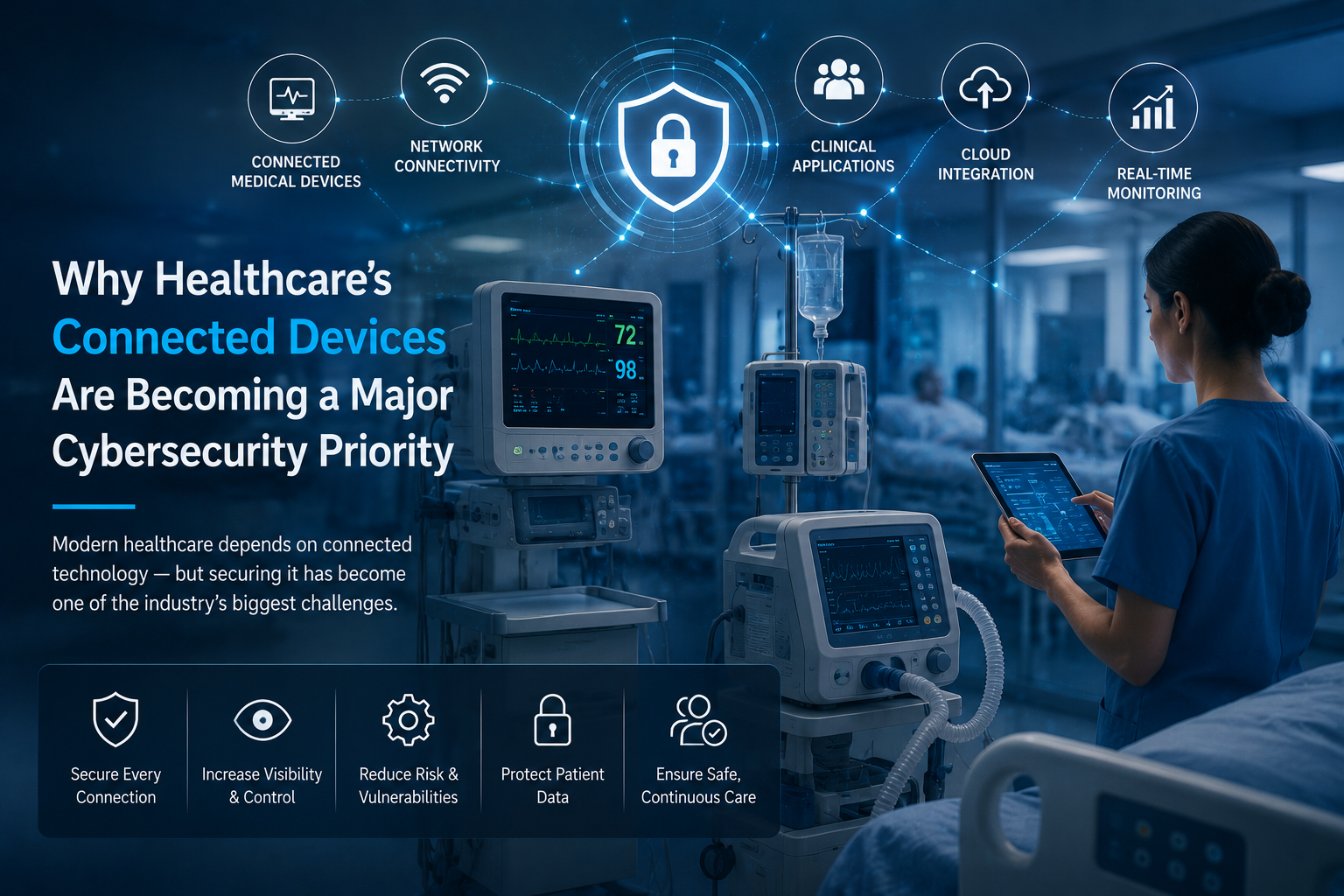
Why Healthcare's Connected Devices Are Becoming a Major Cybersecurity Priority
Modern healthcare depends on connected technology but securing it has become one of the industry's biggest challenges.
Healthcare organizations today operate in one of the most digitally connected environments of any industry.
From smart infusion pumps and patient monitors to imaging systems, ventilators, and connected diagnostic equipment, hospitals now rely on thousands of devices working together in real time to support patient care and clinical operations.
These technologies are helping healthcare providers improve efficiency, accelerate treatment, and deliver better patient outcomes.
But they are also creating a rapidly expanding cybersecurity challenge that many organizations are still struggling to manage.
At CYBRELI, we are seeing healthcare organizations increasingly shift their focus toward securing not only users and applications but also the growing ecosystem of connected medical devices operating across their environments.
Because in today's healthcare landscape, every connected device represents a digital identity that must be trusted, governed, and protected.
The Healthcare Security Model Has Changed
For years, healthcare cybersecurity focused primarily on protecting the network perimeter.
If organizations had:
- Strong firewalls
- Password policies
- Endpoint security
- Basic access controls
Many believed their environments were sufficiently protected. But healthcare environments have evolved dramatically.
Today's hospitals operate highly interconnected ecosystems where:
- Devices communicate continuously
- Cloud applications exchange sensitive information
- Remote access is common
- Clinical systems must remain available at all times
The challenge is that many connected medical devices were never originally designed for today's threat landscape.
Some devices:
- Operate with excessive trust
- Remain unpatched for long periods
- Use outdated software
- Lack sufficient visibility within enterprise security programs
This creates significant exposure for healthcare organizations especially as cybercriminals increasingly target healthcare infrastructures with ransomware and operational disruption attacks.
Connected Devices Are Creating a New Identity Challenge
One of the biggest changes happening in cybersecurity today is the rise of non-human identities.
In modern healthcare environments, machine identities now far exceed human users.
Every connected medical device, application, API, automated process, or system integration requires a digital identity to communicate across networks and access critical resources.
Yet many organizations still focus identity governance primarily around employees and clinical staff. This creates dangerous blind spots.
Without proper governance:
- Device identities may remain unmanaged
- Excessive permissions may go unnoticed
- Compromised systems may move laterally across environments
- Organizations may struggle to contain incidents quickly
As healthcare ecosystems continue expanding, identity governance can no longer focus only on people. It must also extend to devices, systems, and automated technologies operating behind the scenes.
Security Cannot Interfere With Patient Care
Healthcare presents a unique cybersecurity challenge because operational continuity directly affects patient outcomes.
Clinical teams work in high-pressure environments where delays, interruptions, or excessive authentication friction can create operational risks. Security controls that disrupt care delivery are unlikely to succeed long term.
This is why modern healthcare cybersecurity strategies are increasingly focused on invisible security models approaches that strengthen protection while minimizing disruption for clinical staff.
Modern identity-centric security frameworks help organizations:
- Continuously validate trust
- Secure device access automatically
- Isolate suspicious activity faster
- Improve visibility across connected environments
All without adding unnecessary complexity for healthcare professionals.
The objective is not simply stronger security. It is smarter security designed around operational realities.
Why Identity-Centric Security Is Becoming Essential
Traditional security models assumed that systems inside the network could generally be trusted. That assumption no longer works in highly connected healthcare environments.
Modern healthcare organizations are increasingly adopting identity-first security strategies built around:
- Continuous trust validation
- Adaptive access controls
- Intelligent segmentation
- Real-time identity governance
This approach allows organizations to better manage:
- Connected medical devices
- Cloud platforms
- Remote access
- Third-party integrations
- Automated systems
Within a unified security framework instead of granting broad implicit trust, organizations can validate identities continuously and limit access only to what is necessary for operational functions.
This significantly improves:
- Breach containment
- Operational resilience
- Visibility
- Incident response capabilities
Automation Is Becoming Critical for Healthcare Security
Healthcare environments often operate thousands sometimes tens of thousands of connected systems simultaneously. Managing these environments manually is becoming operationally unsustainable.
Modern identity and security programs increasingly rely on automation to:
- Onboard devices securely
- Manage identity lifecycles
- Monitor trust continuously
- Simplify governance
- Reduce human error
Automation helps healthcare organizations improve scalability while reducing the operational burden placed on internal IT and security teams.
As connected healthcare ecosystems continue growing, organizations that invest in automated identity governance and intelligent security operations will be better positioned to support both cybersecurity and clinical efficiency.
The Future of Healthcare Security Will Be Identity-Driven
Healthcare organizations are continuing to accelerate:
- Digital transformation
- Cloud adoption
- AI-enabled healthcare services
- Connected patient care
- Remote healthcare delivery
As these environments become more complex, identity security will become increasingly central to operational resilience and patient trust.
Organizations that continue relying on fragmented visibility and legacy trust models may face growing operational and cybersecurity risks.
Those investing in modern Identity & Access Management strategies today will be better positioned to:
- Reduce cyber exposure
- Improve governance
- Strengthen operational continuity
- Support secure innovation across connected healthcare environments
How CYBRELI Helps
At CYBRELI, we help healthcare organizations modernize identity security through scalable, intelligent, and business-aligned IAM solutions.
Our expertise includes:
- Identity Governance & Administration (IGA)
- Access Management & Federation
- Privileged Access Management (PAM)
- Multi-Factor Authentication (MFA)
- Cloud Identity Security
- Zero Trust Architecture
- Identity Governance for Connected Environments
- Secure Access Modernization
We help organizations strengthen visibility, simplify governance, reduce operational risk, and build secure digital ecosystems designed for the future of healthcare.
Final Thoughts
The future of healthcare cybersecurity is no longer only about protecting networks. It is about protecting identities across an increasingly connected environment of users, systems, applications, and devices.
As healthcare organizations continue modernizing operations and adopting connected technologies at scale, identity-centric security will become one of the most important foundations of resilient healthcare infrastructure.
Organizations that act early will be better positioned to protect operations, strengthen trust, and support secure patient care in a rapidly evolving digital landscape.
Secure Identities. Protect Connected Healthcare. Enable Trusted Care.