







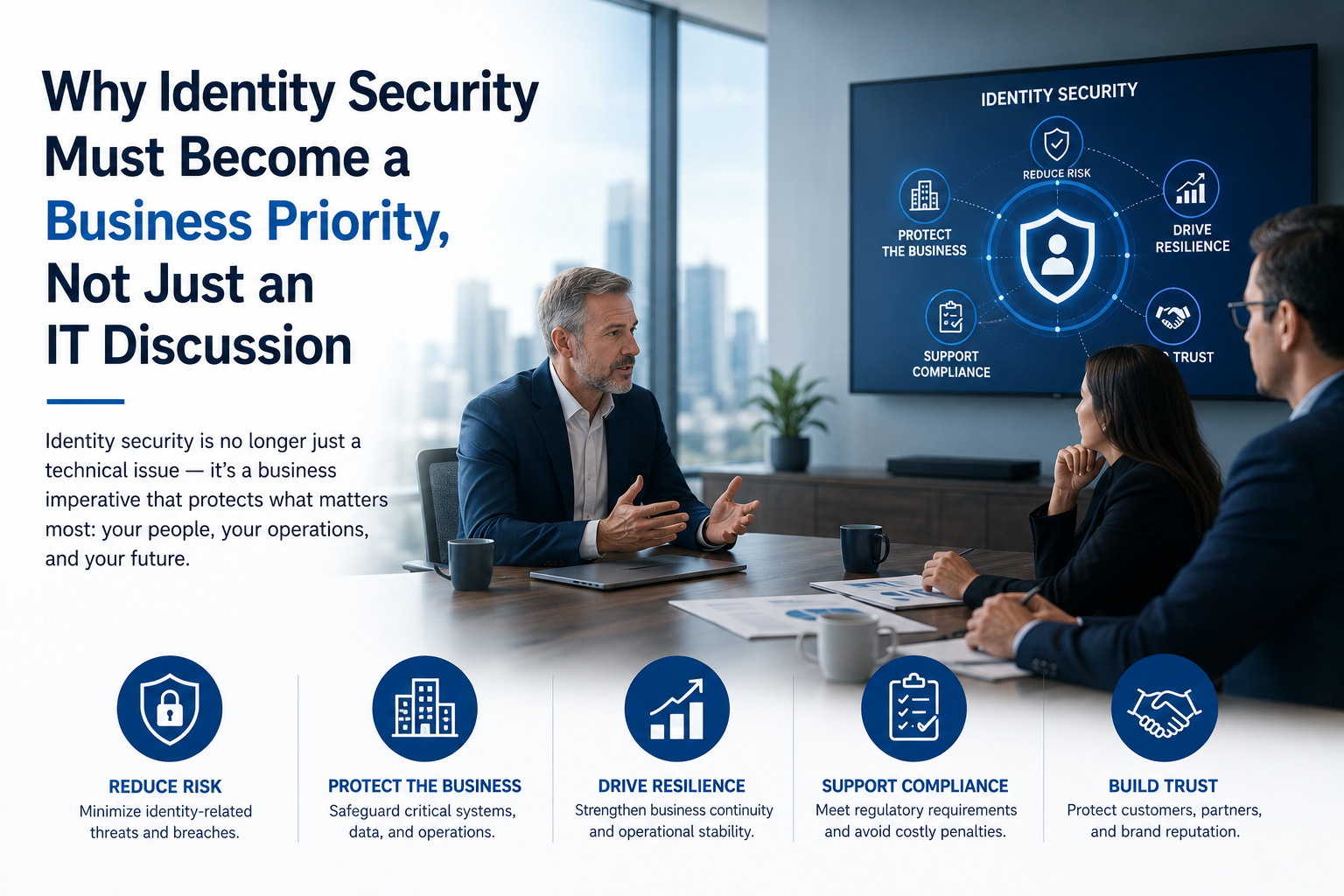
Why Identity Security Must Become a Business Priority, Not Just an IT Discussion
The organizations treating identity security as a business risk today will be the ones better prepared for tomorrow's cyber threats.
For years, cybersecurity conversations inside boardrooms have largely focused on technical risks, vulnerabilities, malware, firewalls, authentication protocols, and security infrastructure.
But for many executive teams, these discussions often feel disconnected from broader business priorities.
When security is communicated only through technical terminology, it becomes difficult for leadership teams to fully understand the operational and financial impact of modern cyber risk.
At CYBRELI, we believe one of the biggest challenges organizations face today is not simply implementing stronger cybersecurity controls. It is aligning identity security with business strategy, operational resilience, and enterprise risk management.
Because in today's threat landscape, identity security is no longer just an IT issue. It is a business issue.
Most Modern Breaches Start With Identity
When organizations think about cyberattacks, they often imagine sophisticated hackers exploiting advanced technical vulnerabilities.
In reality, many of the most damaging breaches begin with something far simpler: a compromised identity.
- An employee account
- A privileged credential
- A contractor login
- An unmanaged service account
- A help desk verification failure
Modern attackers increasingly focus on identity because it provides one of the fastest and most effective paths into enterprise environments.
Once attackers gain access through a trusted identity, they often bypass traditional perimeter defenses entirely.
The result can be devastating:
- Operational disruption
- Financial losses
- Regulatory exposure
- Reputational damage
- Loss of customer trust
The challenge is that many organizations still treat identity management primarily as an operational IT function rather than a strategic business risk area.
Identity Security Is Directly Connected to Business Operations
Identity governs access to nearly every critical business function:
- Financial systems
- Customer platforms
- Healthcare applications
- Operational technologies
- Cloud environments
- Executive communications
When identity security fails, the impact extends far beyond cybersecurity teams. It affects revenue, operational continuity, customer trust, compliance, and business reputation.
This is why forward-looking organizations are increasingly integrating Identity & Access Management (IAM) into broader enterprise risk and governance strategies.
Strong identity governance is no longer simply about controlling access. It is about protecting the organization's ability to operate securely and continuously.
Cybersecurity Conversations Must Evolve at the Executive Level
One of the biggest barriers to executive buy-in is communication.
Boards and executive leadership teams do not make decisions based solely on technical terminology. They evaluate business impact, operational risk, financial exposure, and strategic priorities.
This means cybersecurity leaders must increasingly position identity security in the language of business outcomes.
Instead of discussing authentication frameworks, privileged credentials, or access protocols, organizations should focus conversations around:
- Operational resilience
- Regulatory risk
- Business continuity
- Fraud prevention
- Customer trust
- Financial impact
Identity security becomes significantly easier to prioritize when leadership understands how directly it affects business performance and organizational stability.
The Cost of Reactive Security Continues to Grow
One of the biggest mistakes organizations make is treating cybersecurity investment as a reactive expense rather than a strategic business investment.
The financial impact of modern cyber incidents often extends far beyond the initial breach itself.
Organizations may face:
- Operational downtime
- Remediation costs
- Legal exposure
- Compliance penalties
- Customer churn
- Increased cyber insurance costs
- Long-term reputational damage
In many cases, the indirect business impact becomes more damaging than the technical incident itself.
By contrast, proactive investment in identity governance and modern IAM strategies helps organizations reduce operational risk, strengthen compliance, improve visibility, simplify access management, and support long-term digital resilience.
The organizations investing early in identity security are often better positioned to adapt to future business and cybersecurity challenges.
Identity Security Is Also a Business Enabler
One of the most overlooked aspects of modern IAM is that it does more than reduce risk. It also enables business growth.
Modern identity security supports:
- Secure remote work
- Cloud transformation
- Digital customer experiences
- Mergers and acquisitions
- Third-party collaboration
- Secure enterprise innovation
When identity governance is modernized effectively, organizations gain stronger operational efficiency, faster onboarding, improved user experiences, and more scalable security operations.
Identity security should not be viewed solely as a defensive measure. It is becoming a foundational layer of modern digital business operations.
The Future of Cybersecurity Will Be Identity-Centric
As organizations continue accelerating cloud adoption, AI integration, remote access, digital transformation, and connected ecosystems, identity will become even more central to enterprise security strategy.
Traditional perimeter-based models are no longer sufficient for highly distributed digital environments.
Modern cybersecurity increasingly depends on continuous identity validation, adaptive access controls, governance automation, privileged access management, and Zero Trust security principles.
Organizations that modernize identity governance today will be significantly better prepared to reduce cyber risk, support innovation, improve resilience, and strengthen long-term business trust.
How CYBRELI Helps
At CYBRELI, we help organizations modernize identity security through intelligent, scalable, and business-aligned Identity & Access Management solutions.
Our expertise includes:
- Identity Governance & Administration (IGA)
- Privileged Access Management (PAM)
- Access Management & Federation
- Multi-Factor Authentication (MFA)
- Cloud Identity Security
- Zero Trust Architecture
- IAM Strategy & Advisory Services
We help organizations strengthen governance, reduce operational risk, improve compliance readiness, and build secure digital ecosystems capable of supporting long-term business growth.
Final Thoughts
Cybersecurity is no longer only a technical discussion. It is a business resilience discussion.
Organizations that continue treating identity security as a secondary IT function may struggle to keep pace with evolving cyber threats, operational complexity, and digital transformation demands.
Those that recognize identity as a strategic business priority will be better positioned to strengthen resilience, protect trust, support innovation, and enable secure growth in an increasingly connected world.